

Crank Length Guide 2026: Does Crank Size Affect Cycling Performance?
- Mar 27
- 3 min read
Updated: Mar 29

When it comes to improving cycling performance, most riders focus on upgrades like a carbon wheelset or aero wheels. However, one component that is often overlooked is crank length.
Crank length plays a key role in how efficiently you pedal, how comfortable you feel on the bike, and how well you can maintain an aerodynamic position. Understanding it can help you make a smarter road bike upgrade decision.
What Is Crank Length?
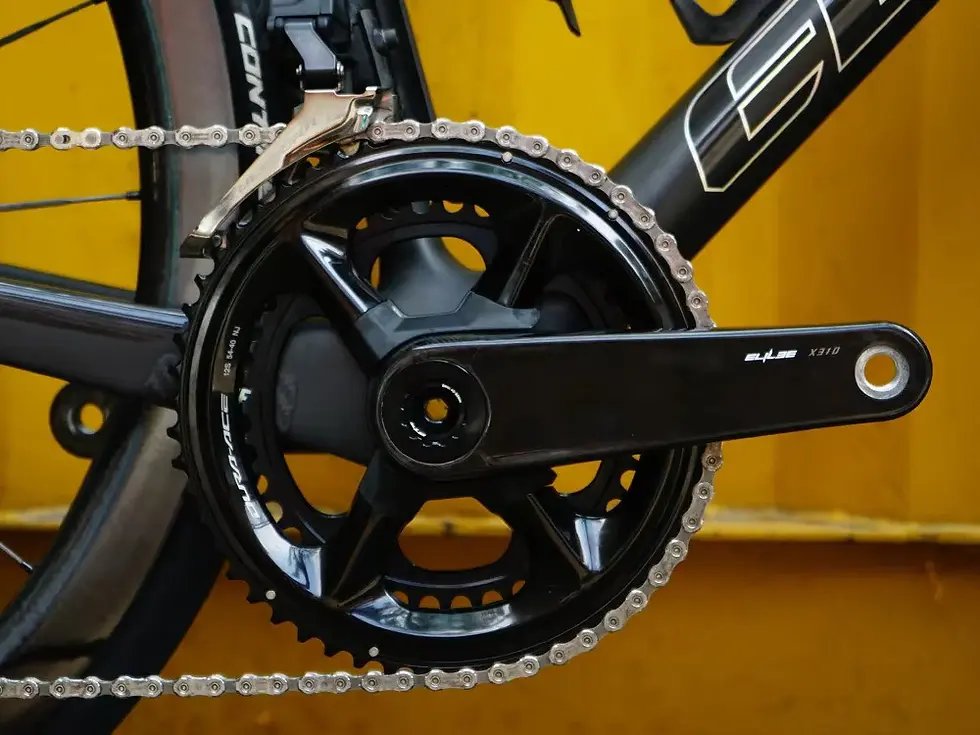
Crank length is the distance between the center of the bottom bracket and the pedal axle. Common sizes on road bikes include 165mm, 170mm, 172.5mm, and 175mm.
Most manufacturers default to 172.5mm cranks for medium-sized bikes. While this works for many riders, it is not always the most efficient choice for individual body proportions or riding style.
Does Crank Length Affect Power Output?
One of the biggest misconceptions is that longer cranks automatically generate more power.
In reality, research shows that the effect is minimal. Studies in cycling biomechanics have found that changing crank length within a typical range (165–175mm) results in less than a 2% difference in peak power output.
This means that for most riders, crank length does not significantly impact how much power you can produce. Instead, it influences how efficiently you apply that power.
Where Crank Length Makes a Difference
Pedaling Efficiency
Shorter cranks reduce the range of motion at the hip and knee joints. This allows riders to spin at higher cadences more comfortably.
Many cyclists find it easier to maintain a cadence of 90–100 rpm with shorter cranks, especially during long rides or high-intensity efforts.
Aerodynamic Position
Crank length has a direct effect on body positioning. Shorter cranks reduce how high your knees rise at the top of each pedal stroke.
This makes it easier to maintain a lower torso position, which improves aerodynamics. For riders focused on speed, this can be just as important as using aero wheels.
Comfort and Injury Prevention
Longer cranks increase joint movement, which can put additional stress on the knees and hips.
Riders experiencing discomfort or tightness may benefit from switching to shorter crank arms. Even a small change — such as moving from 172.5mm to 170mm — can improve comfort over long distances.

Crank Length and Rider Height
There is no perfect formula, but general guidelines can help:
Riders under 170cm: 165–170mm
Riders between 170–180cm: 170–172.5mm
Riders over 180cm: 172.5–175mm
However, flexibility, riding posture, and personal preference are just as important as height.
Real-World Performance Impact
While crank length does not dramatically change peak power, it affects several key factors:
Cadence efficiency
Aerodynamic positioning
Long-distance comfort
These elements all contribute to overall cycling performance, especially when combined with other upgrades like a lightweight road bike setup or improved tire systems.
Should You Change Your Crank Length?
You may benefit from adjusting your crank length if:
You struggle to maintain high cadence
You experience knee or hip discomfort
You want to optimize your aerodynamic position
For many riders, slightly shorter cranks provide a better balance of comfort and efficiency without sacrificing performance.
Final Thoughts
Crank length is not about producing more power — it is about using your power more effectively.
When combined with upgrades such as a carbon wheelset, optimized tire setup, and proper bike fit, the right crank length can contribute to a smoother and more efficient ride.
Small adjustments in your setup can lead to noticeable improvements over time.
Related products


Comments